Columbia Spray Foam Works: Spray Foam Insulation for Homes, Pole Barns, and Commercial Buildings in Columbia, MO

Columbia Spray Foam Works is a spray foam insulation contractor with over 15 years of experience serving Columbia, MO and the surrounding communities. Our residential work covers attic, crawl space, wall, basement, and rim joist spray foam insulation, along with air sealing and insulation upgrades. We also insulate pole barns, metal buildings, and commercial properties. We are fully insured, our installers are SPF manufacturer-certified, and we offer free estimates with financing available.

Our proportioner rig meters both components of the spray foam at an exact 1:1 ratio. An off-ratio mix leaves odor, shrinkage, and soft spots, and cured foam cannot be corrected, only removed. We install both open-cell and closed-cell spray foam. Open-cell is softer and sound-absorbing; closed-cell is dense enough to limit moisture movement. Every project starts with a written scope naming the selected foam and target R-value, the rating for resistance to heat flow. The finished work seals air leaks and holds rooms at steadier temperatures, and we document what was installed.

We work across Boone County and the counties around it, from Ashland and Hallsville to Boonville and Fayette. Sticky summers and sharp winter swings put insulation to work here. We still work in houses we insulated a decade ago, and the foam is performing the way it did on day one.

Get A Free Quote

Why Choose Columbia Spray Foam Works for Spray Foam Insulation

  • Columbia Spray Foam Works brings over 15 years in business, general liability coverage, and workers’ compensation coverage to each project. Estimates are free, and financing is available.
  • Our installers hold SPF manufacturer certification for the Spray Polyurethane Foam products they apply, the credential foam makers require before they will sell raw A- and B-side chemical sets or honor a product warranty.
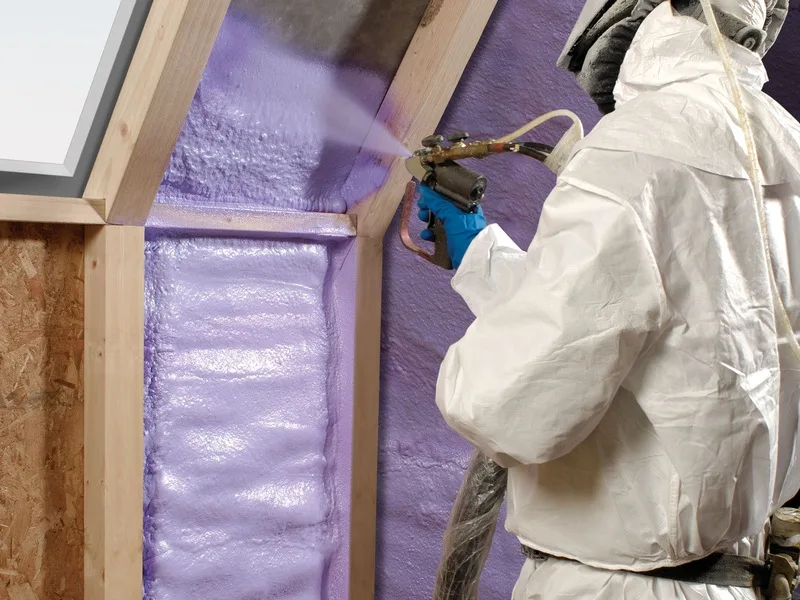
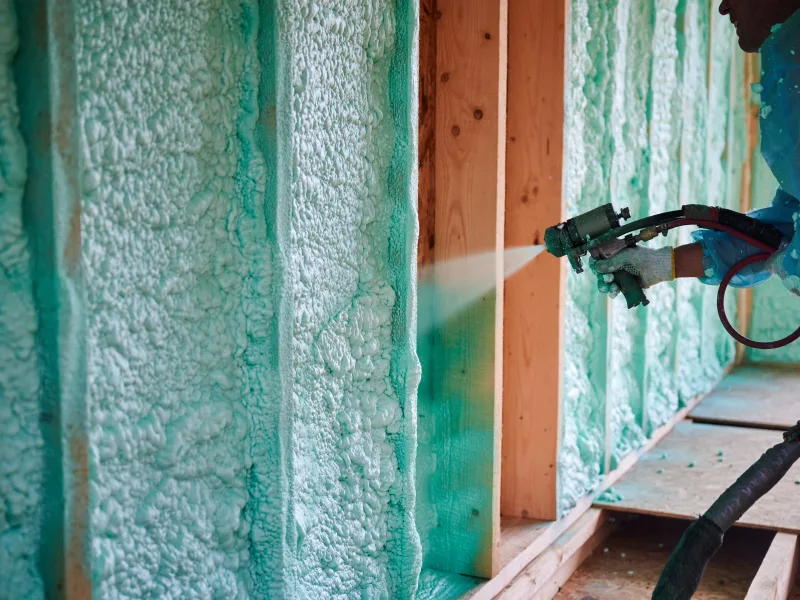
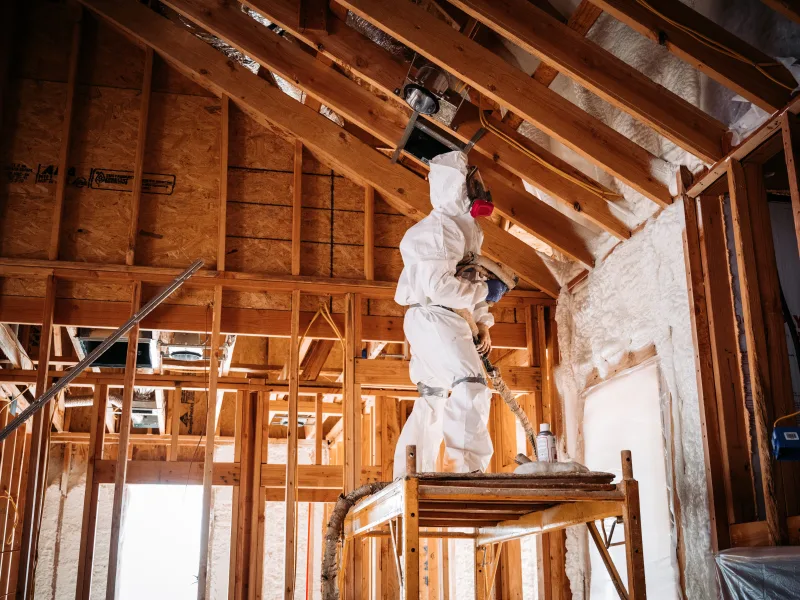
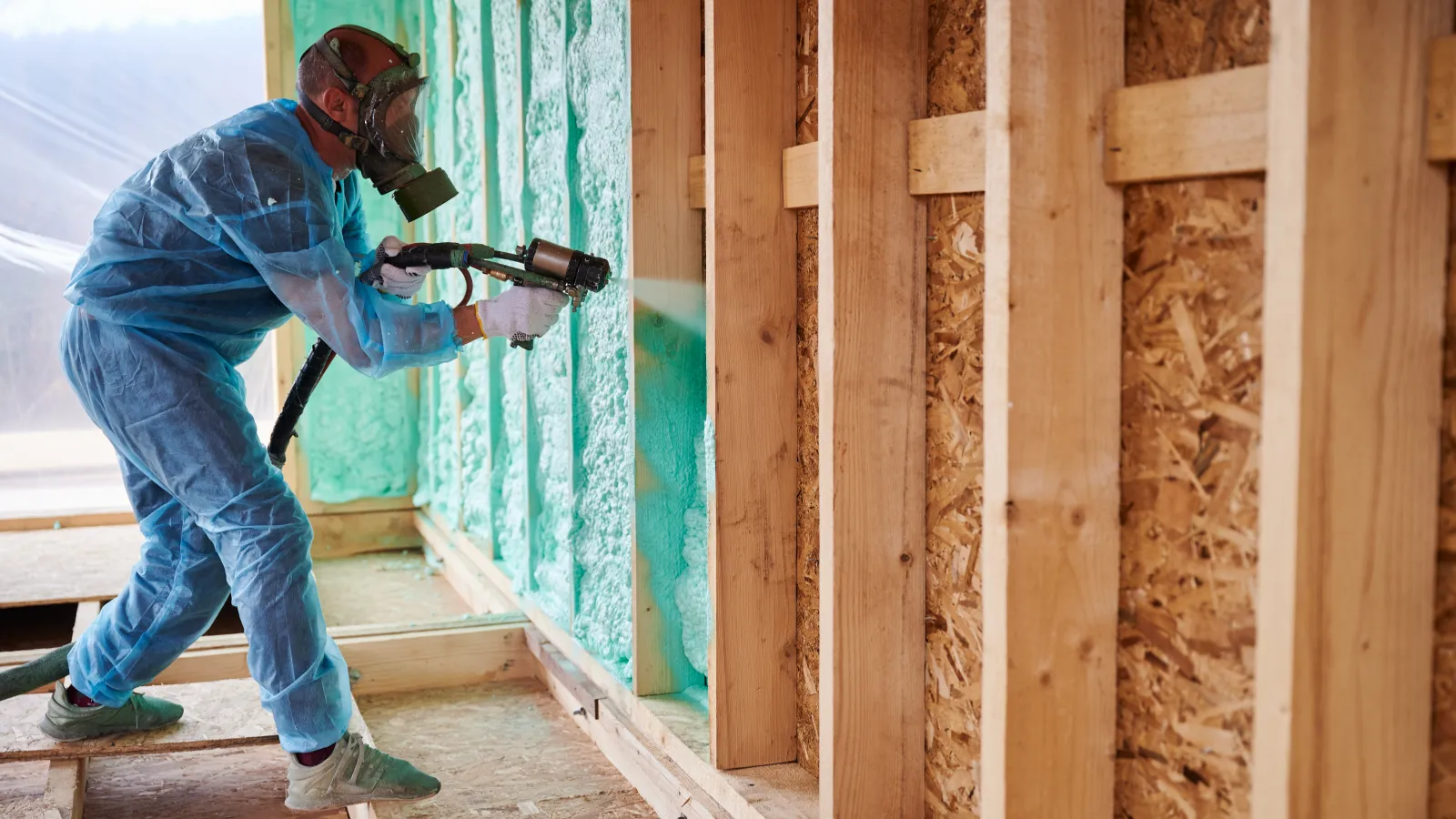
Certified applicator in a full-face respirator and coveralls spraying foam into a wall cavity
  • We monitor the 1:1 mix ratio and proportioner temperature window on every pass. Both components stay within the manufacturer’s specified range for proper curing.
  • Our crews use negative-pressure ventilation and containment zoning to isolate the work area. OSHA-compliant PPE protocols protect installers, while written re-entry timing tells occupants when the building is ready.
  • Every written scope identifies the assembly, foam type, thickness, and target R-value. You can compare the completed spray foam insulation directly with the quoted specifications.
  • Closeout documentation is handed over when the job closes, not promised and forgotten, and it is specific enough to check the installed system against what you were quoted.
  • Our written workmanship warranty covers the installation itself and remains separate from the foam manufacturer’s product warranty.
  • Our Mid-Missouri experience covers older homes, vented crawl spaces, pole barns, barndominiums, and metal buildings.
  • We use the same rig controls and application checks for a one-day rim joist project and a complete commercial shell.

Spray Foam Applications

Columbia Spray Foam Works handles residential and commercial spray foam projects, with rig capacity for a one-room retrofit or a full building shell. What changes from job to job is the foam type, the thickness, and the covering the code requires over it, so every assembly gets looked at before anything gets quoted.

Attic Spray Foam Insulation

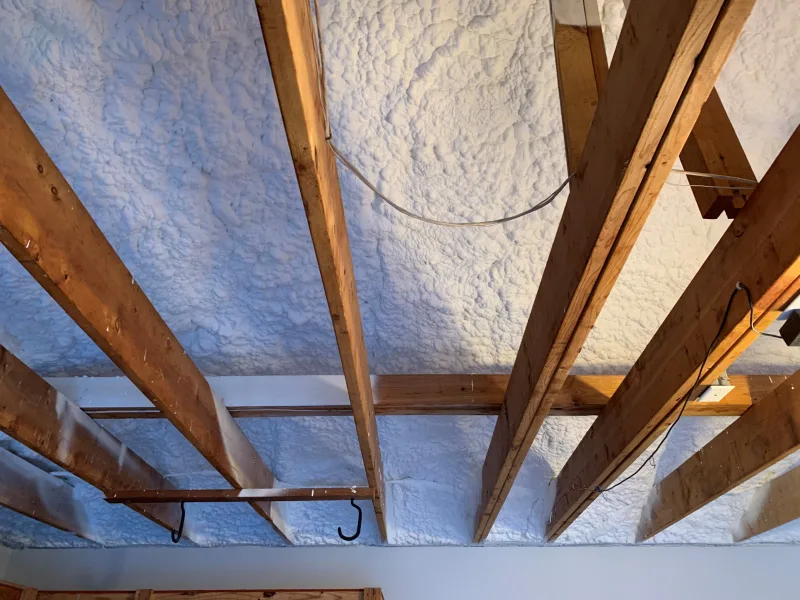
Open-cell foam sprayed along an attic roof deck between rafters

Upstairs bedrooms that run hot, an air conditioner that never quite shuts off, ice building along the eaves in January. Those all point at the attic. The real question is where the insulation belongs: down on the attic floor, or up along the roof deck in an unvented assembly. That one answer changes the entire job, and it often turns on whether the ductwork and air handler are up there. When they are, bringing the attic inside the conditioned space is frequently worth the extra cost, because the equipment stops fighting attic air that runs far hotter than anything outdoors. Either way the target is the applicable code level, commonly R-49 to R-60, and the attic ends up either properly vented or deliberately inside the envelope. What it cannot be is halfway between the two.

Crawl Space Spray Foam Insulation

Technician in a respirator spraying foam onto the underside of the floor in a crawl space, over a ground vapor barrier

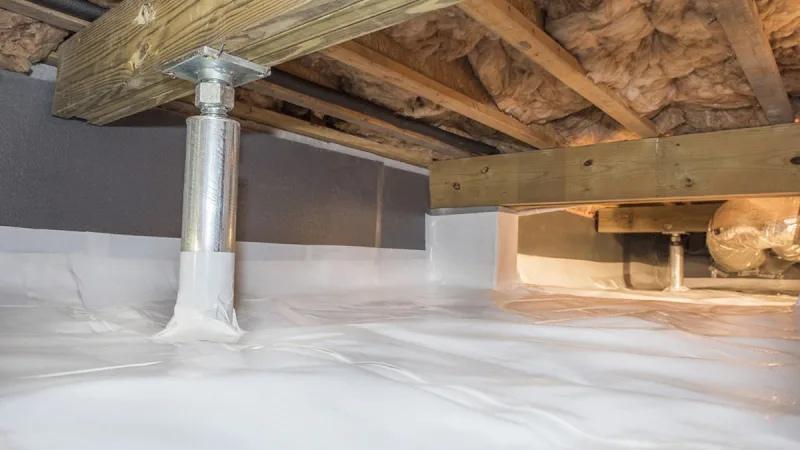
Cold floors in winter, a musty smell that comes and goes, ducts sweating under the house. We look at the foundation, drainage, vents, and mechanical equipment before deciding whether to seal the crawl or leave it vented, because that choice determines where the insulation belongs. Closed-cell foam carried up the foundation walls cuts air leakage and moisture movement at the perimeter, with thickness set by the R-value the assembly needs. If there is ground moisture or humidity to deal with as well, that work gets scoped alongside it.

Pole Barn Spray Foam Insulation

Interior of a post-frame building with spray foam over the roof deck and wall panels between the girts

Water dripping off the underside of a metal roof onto a tractor, a workbench, or stored feed is the complaint we hear most from barn owners. It is condensation, not a leak: humid air inside the building meeting cold steel overhead. Two inches of closed-cell sprayed direct to the roof panels puts a warm surface between the two and stops it. We work the foam around purlins and girts so the post-frame shell has no gaps, then size wall thickness to what the barn is actually used for.

Commercial Spray Foam Insulation

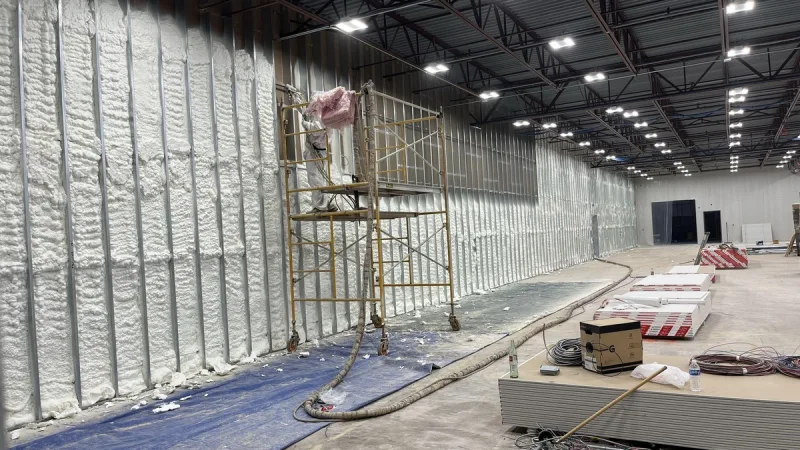
Spray foam applied to the walls of a commercial warehouse under construction, rolling scaffold and hose run on the slab below open-web steel joists

Commercial work answers to three things at once: how the building operates, what the drawings say, and what the energy code requires. We insulate warehouses, offices, retail spaces, and agricultural buildings with IECC compliance built into the assembly rather than bolted on after. Our equipment covers shells past 50,000 square feet. Scheduling is usually the harder problem, so we work after hours when daytime spraying would interrupt staff, customers, or production, and run the job zone by zone so the rest of the property keeps operating.

Barndominium Spray Foam Insulation

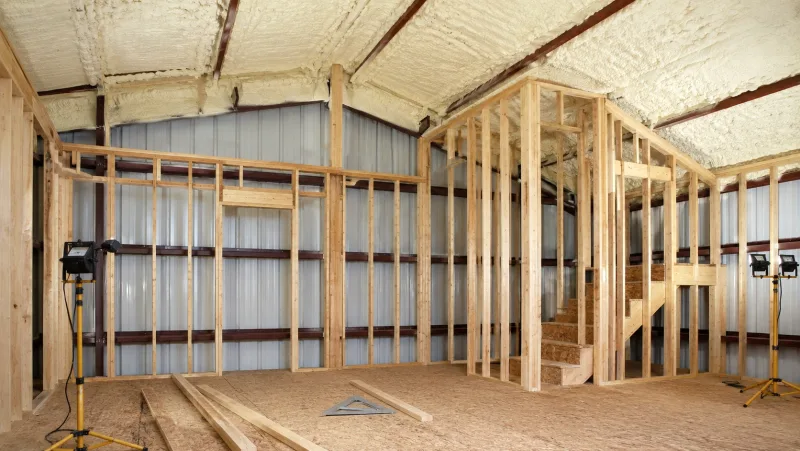
Wood-framed interior partition walls built inside a metal building shell, with spray foam across the metal roofline above

A barndominium is a house wearing a barn’s shell, and it needs a house’s envelope inside it. We design that envelope around the roofline, the exterior walls, the mechanical spaces, and wherever sound needs to stop between living areas and working ones. Usually that means closed-cell against the exterior metal and open-cell in the deeper framed and interior cavities, with ceilings specified to R-49 or better. Done that way it lives like a house instead of an intermittently heated workshop.

Metal Building Spray Foam Insulation

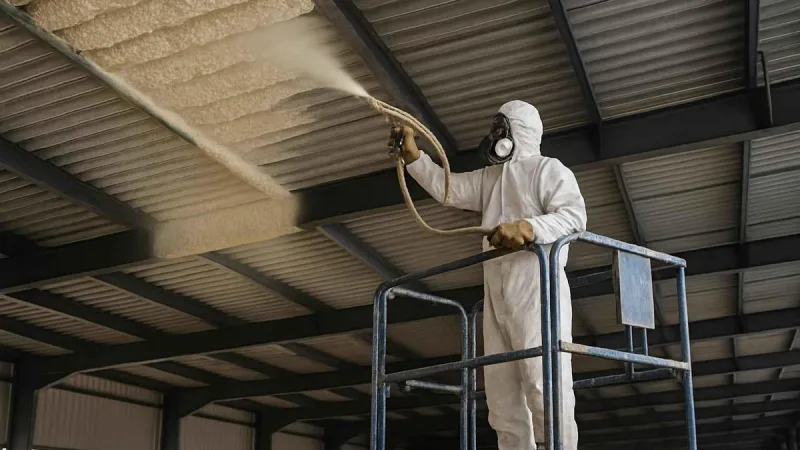
Applicator on a lift spraying a continuous layer of foam across the metal roof deck of a steel building

Steel framing carries the outdoors straight through the wall. That is thermal bridging, and it is why insulation packed only between the members underperforms in an engineered steel building. Foam applied continuously across the interior face avoids it. For a conditioned shop or warehouse the shell target is commonly R-13 to R-19, depending on the building design and energy code. Continuity matters more than the number, because any break in the layer becomes the one spot where interior moisture reaches bare panel and corrosion starts.

New-Construction Spray Foam Insulation

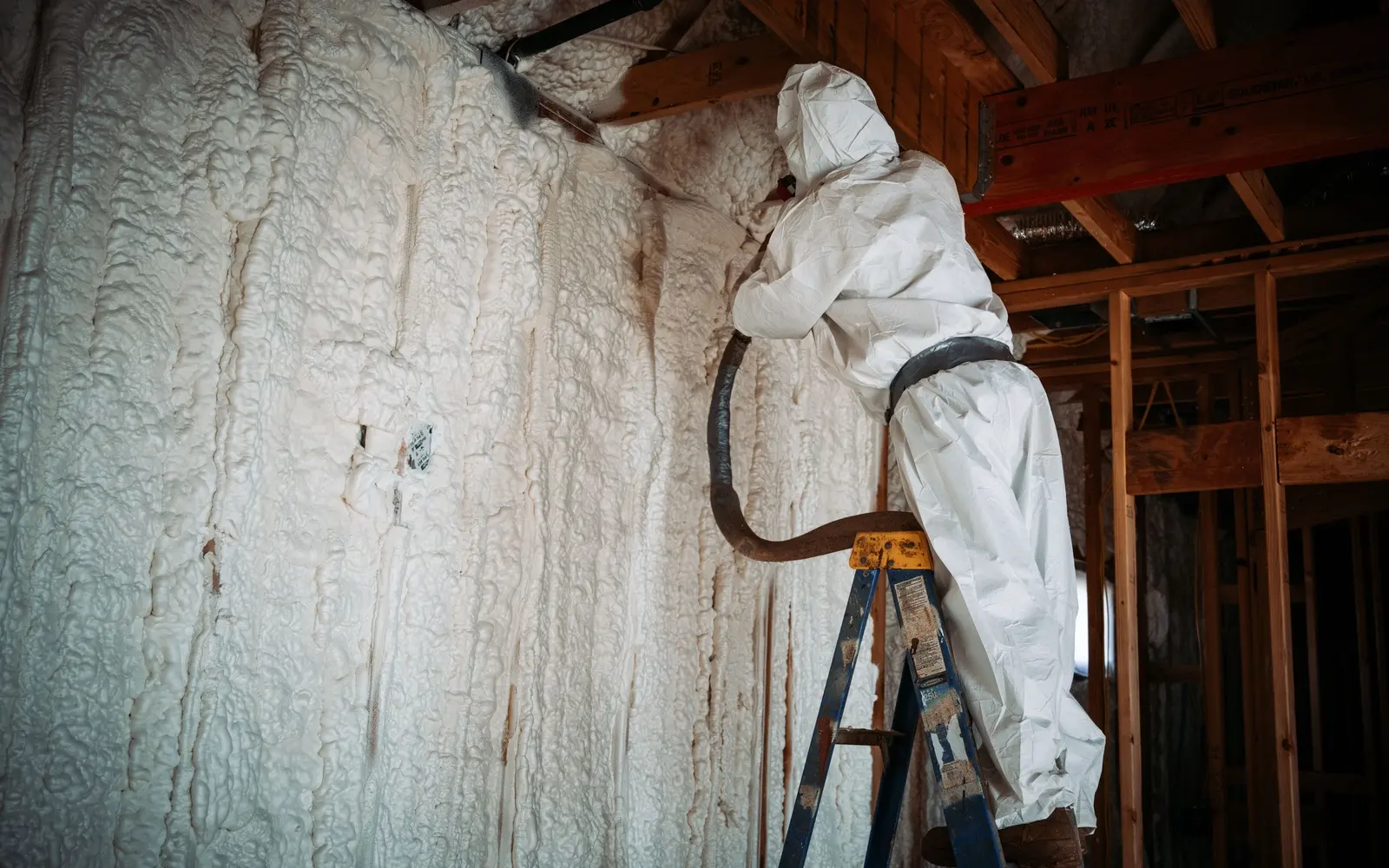
Foam going into a new-construction wall assembly ahead of drywall

On new construction you get exactly one shot at the envelope before drywall covers it. We schedule around framing, electrical, plumbing, and mechanical inspections so foam never goes over something that still needs correcting or signing off. A properly specified air seal is what gets a house under the 3 ACH50 blower-door limit that applies in this climate zone, meaning fewer than three complete air changes an hour at test pressure. For a builder the point is that insulation lands inside the schedule instead of becoming the thing everyone waits on.

Wall Spray Foam Insulation

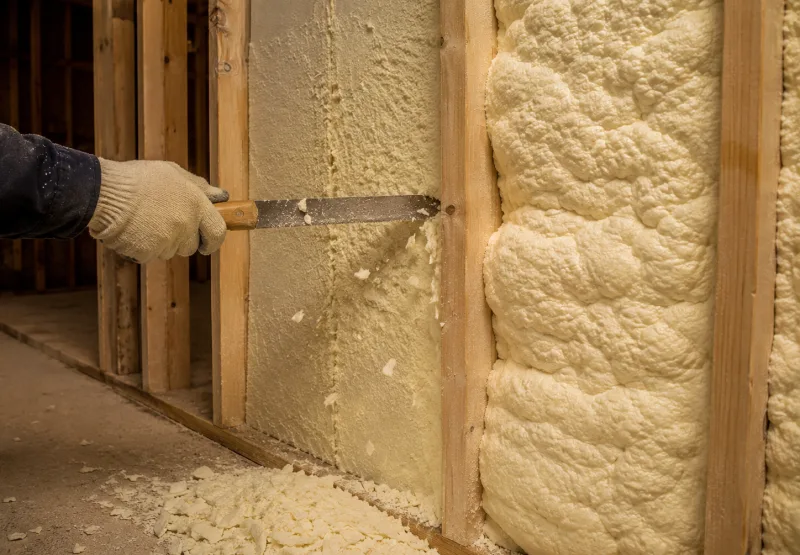
Foam filling stud bays around wiring and an outlet box before trimming

A stud bay is never a clean rectangle. Wiring, pipes, corners, and blocking interrupt it, and batts or boards leave a gap around every one of them. Foam forms to whatever is in the way, which is why an open wall is worth taking advantage of, whether that is new framing or a remodel that has the cavity exposed. Open-cell fills a 2x4 bay at roughly R-13, depending on the product. Once it cures we trim it flush so the stud faces are clean for the drywall crew.

Basement Spray Foam Insulation

Unfinished basement with spray foam applied at the rim joist band and around the framing against a block foundation wall

Bare foundation concrete pulls heat out of a basement and collects condensation in humid weather. Where the wall is sound and dry enough, closed-cell sprayed direct to the concrete handles both. Two inches runs about R-13, past the R-10 continuous minimum many basement assemblies are held to. Cover it as the code requires and the wall is ready to frame.

Garage Spray Foam Insulation

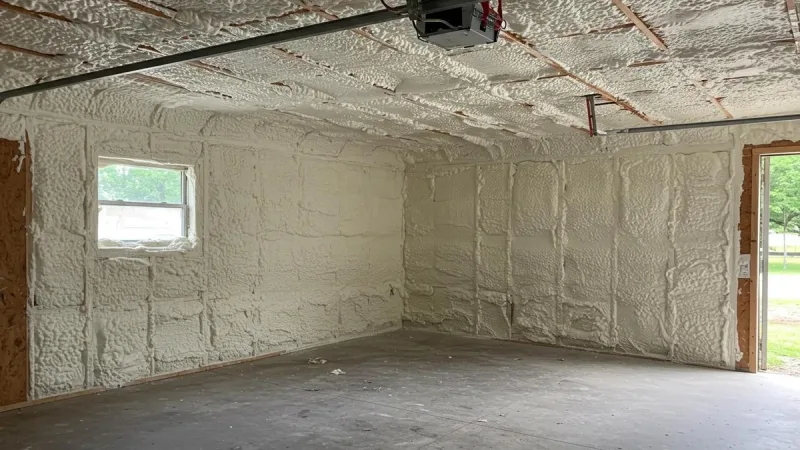
Detached garage with spray foam filling the wall stud bays and the ceiling joist cavities, overhead door open to the yard

An attached garage puts a large cold surface right against the house, through the shared wall and the ceiling underneath a bonus room. That bonus room is the single most common comfort complaint we get, so those cavities come first. A detached shop is a different job with a different goal, making the building usable in February rather than protecting the house next to it. Either way, foam left exposed in an unfinished garage needs its protective covering, and that is priced in rather than left for later.

Rim Joist Spray Foam Insulation

Rim joist cavities sealed with spray foam between the floor joist ends

The rim joist is the band of framing where the floor sits on the foundation, and batts almost never seal it. We spray two to three inches of closed-cell around the joist ends, sill plates, and penetrations, usually in a day. That shuts down stack effect, where warm air rising through the house pulls cold air in at the bottom.

Other Insulation Services

Not every assembly calls for foam, and Columbia Spray Foam Works would rather install what the building needs than push foam into every job. These are the non-foam options, specified and documented the same way.

Blown-In Insulation

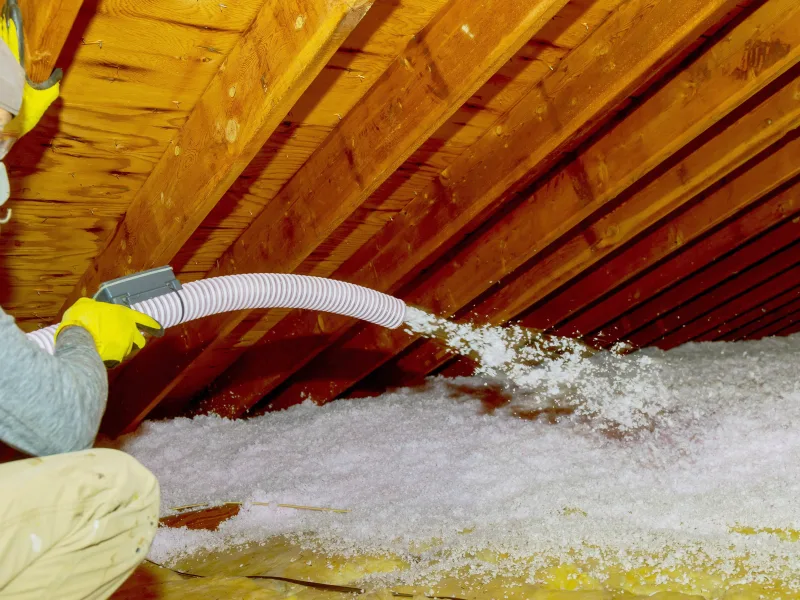
Installer blowing loose-fill insulation to depth across an attic floor

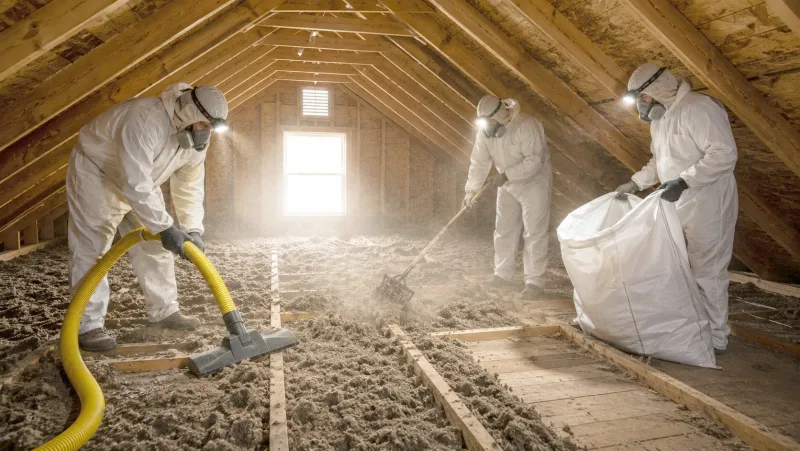
Blown-in is the fastest way to bring an accessible attic up to depth. Thirteen to fourteen inches of loose-fill fiberglass or cellulose gets you to roughly R-49, depending on how the product settles. We leave depth markers so you can check it yourself. Most top-ups are finished in a day.

Fiberglass Insulation

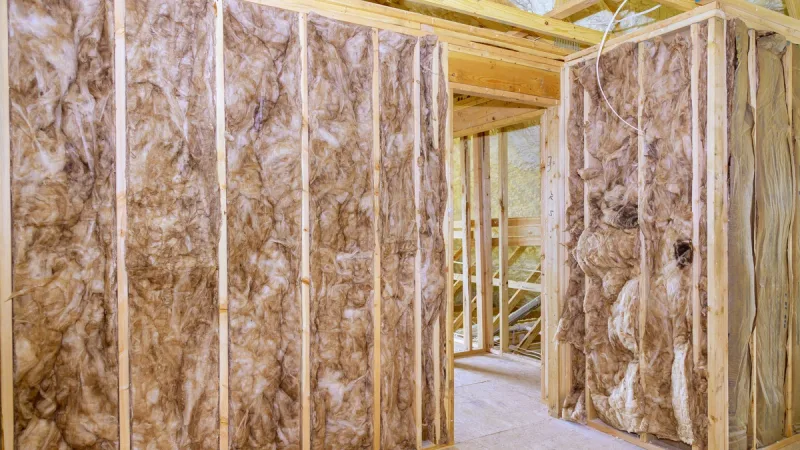
Fiberglass batts filling every stud bay at full loft across a framed interior wall, dry and ready for drywall

Fiberglass is the right answer more often than the foam industry likes to admit. It wins on cost per R, and it wins whenever somebody may need to open that cavity again later. What it asks in return is regular framing, a dry cavity, and room to sit at full loft. Take any one of those away and the number on the package stops meaning much, and that is when we will tell you to spend the money on foam instead.

Fiberglass Batt Insulation

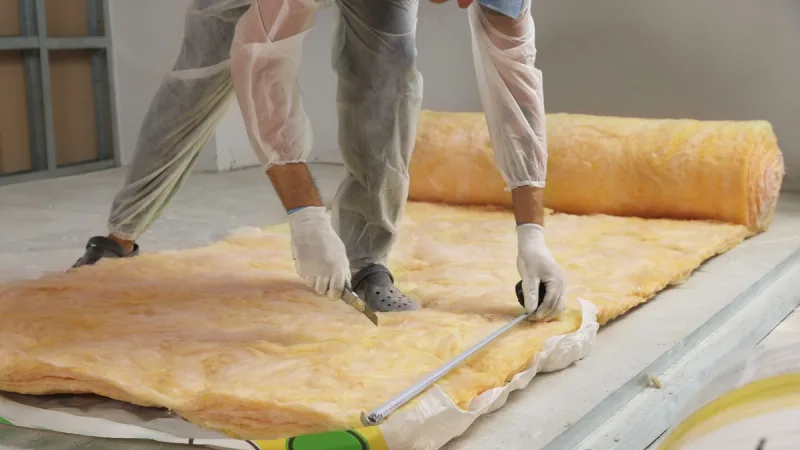
Worker measuring and cutting a fiberglass batt to length with a knife and tape before it goes into the bay

Batts live or die on the fit. The number on the label assumes the batt touches all six sides of the bay with no gaps, no folds, and nothing compressed, so that is how we install them. Standard sizing runs R-13 in a 2x4 wall and R-19 to R-21 in a 2x6. Around boxes, wires, and pipes we cut the batt to fit instead of stuffing it in behind, which is the single most common thing we find wrong in somebody else’s work. Faced, unfaced, or sound batts depends on the assembly.

Residential Spray Foam Insulation

Almost nobody calls asking for closed-cell foam. They call because a room is cold, a floor is cold, or a bill went up. So we work backward from what you are feeling to whatever is causing it, and build the job around that.

Common Problem Areas in Columbia Homes

Attic bypasses often show up as chilly rooms, uneven upstairs temperatures, or rising utility use. Bare rim joists can leave floors cold near exterior walls. Knee walls and rooms over garages may become uncomfortable during both summer and winter. Much of Columbia’s 1950s-70s housing reflects R-11-era construction, so several weak areas can contribute to the same comfort complaint.

Whole-Home vs. Single-Area Projects

The attic almost always goes first, because it pays back fastest, followed by the rim joist and any walls a remodel has already opened. A single-area job is perfectly normal; one rim joist is a real project and we will quote it as one. Bigger upgrades can be split across seasons instead of done at once. Comfort, access, and budget set the order.

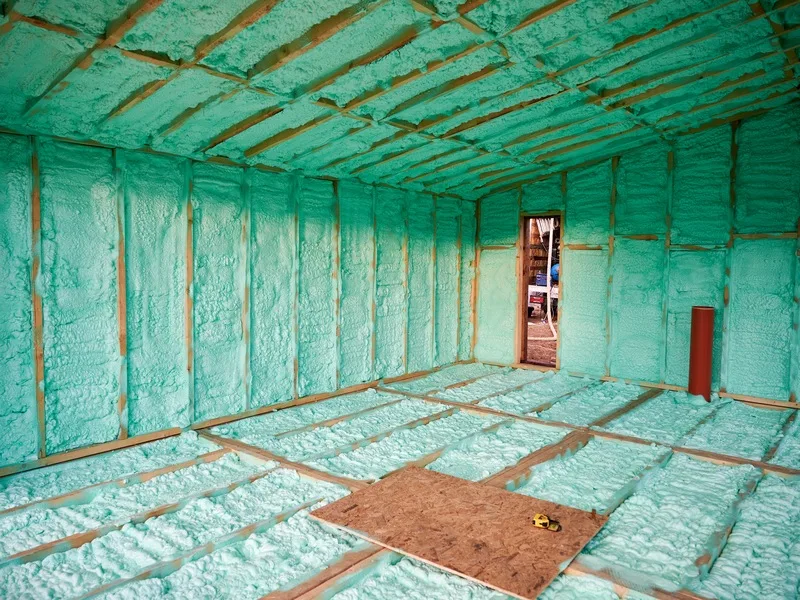
Installer spraying closed-cell foam in a sloped knee-wall ceiling beside a skylight Whole-home scope: walls, ceiling and floor joists of a framed shell fully foamed

When Spray Foam Is the Right Choice, and When It Is Not

Foam works when the assembly underneath it is dry and sound. When it is not, spraying anyway just seals the problem in behind an inch of plastic, and we have been called back to enough of those to say so before quoting rather than after. Sometimes the honest answer is a different material, a different location, or a smaller job than you came in expecting.

Fix These Problems First

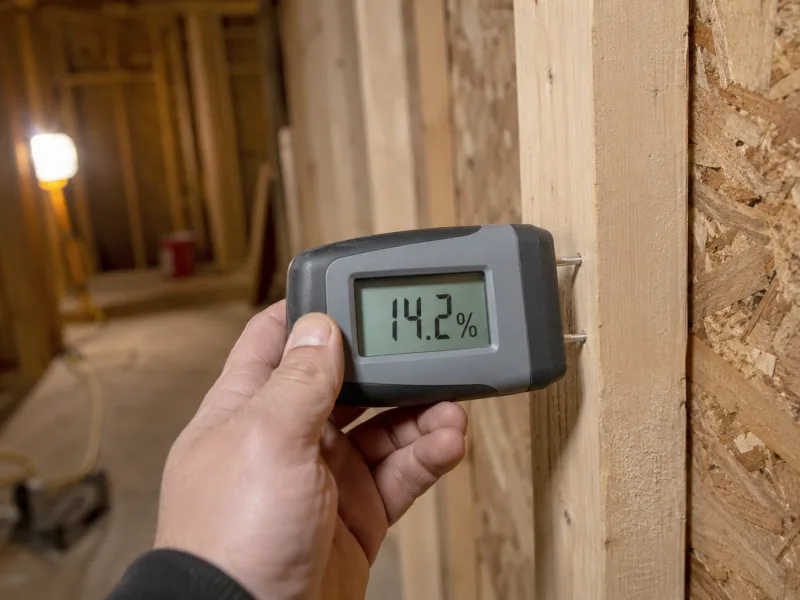
Find the water first. Active roof leaks, plumbing leaks, and damp framing all have to be fixed before anything gets sprayed. We walk the sheathing and framing while it is still visible, because once foam is on it, the surface underneath is out of sight for good. We also use a moisture meter to verify substrate moisture limits. Wood generally needs to read at or below 19%, subject to the foam manufacturer’s instructions, before application begins.

When Another Insulation Makes More Sense

If the insulation belongs on the attic floor rather than up at the roof deck, fiberglass or cellulose above the ceiling usually beats foam along the rafters. Rigid board or a hybrid assembly can win too, wherever cavity depth, access, or material cost is driving the design. We treat an unvented attic as a designed system; any thermal/ignition barrier requirement adds material and labor to the scope.

Pin-type moisture meter reading 14.2 percent on a wall stud before spray foam is applied Spray gun laying foam across open stud bays along a framed wall

Open-Cell vs. Closed-Cell Spray Foam

Both types of polyurethane foam insulation create an air seal, but their physical properties differ enough that they are not interchangeable. Density drives insulation value, vapor permeability, sound absorption, cost, and application fit.

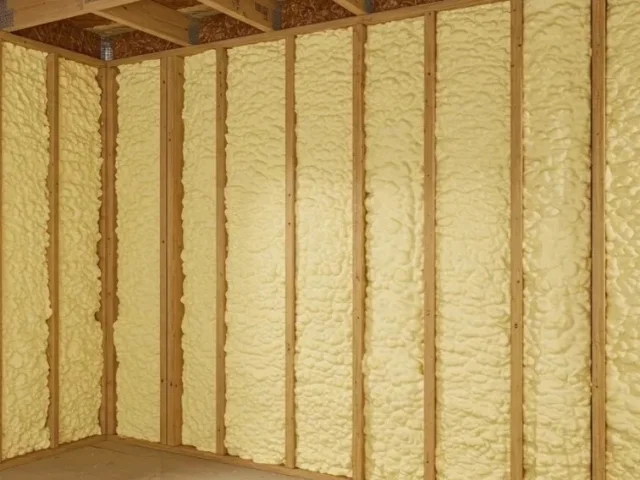
Open-cell spray foam filling every stud bay of a framed wall, pale yellow and packed flush with the stud faces

Open-Cell Spray Foam Insulation

Open-cell foam fills irregular interior cavities while adding sound absorption between occupied spaces. This expanding foam insulation has a light 0.5-lb foam density and delivers about R-3.5 to R-3.8 per inch. Its roughly 100x expansion allows the material to reach around wiring and into narrow gaps without a dense layer. The softer cell structure makes expanding foam useful in rooflines, framed walls, and sound-sensitive rooms. It also costs less per board foot than closed-cell foam where greater installed depth is available.

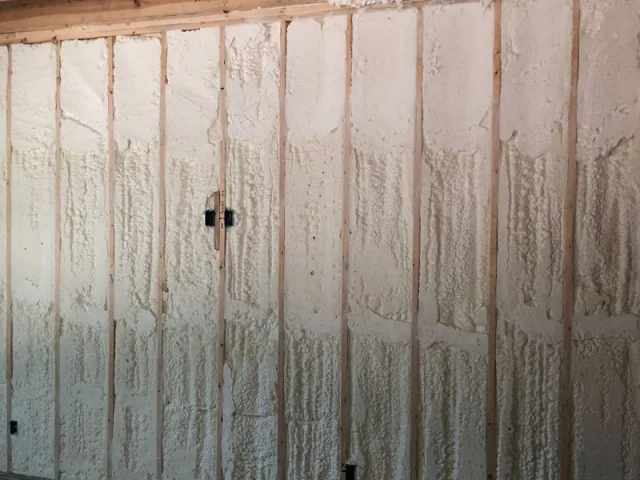
Closed-cell spray foam in a framed basement wall, dense and off-white, sprayed to a partial depth that leaves the stud faces proud

Closed-Cell Spray Foam Insulation

Closed-cell foam fits moisture-exposed or depth-limited assemblies that need substantial R-value in a narrow space. It provides about R-6 to R-7 per inch and has a 2-lb foam density, so it cures into a dense, rigid layer. At roughly 2 inches, many approved products test below 1 perm and qualify as a Class II vapor retarder. The material works well on foundation walls, rim joists, and metal panels where the insulation must control air movement while limiting water-vapor transmission.

Factor Open-Cell Foam Closed-Cell Foam
Density Softer, lower-density Dense, rigid
Expansion Expands more Expands less
R-value per inch Lower Higher
Vapor permeability More permeable Lower permeability
Sound reduction Better sound absorption Less sound-absorptive
Relative cost Usually lower Usually higher
Common applications Walls, rooflines, residential cavities Rim joists, crawl spaces, metal buildings, limited-depth cavities
Structural rigidity Minimal Adds rigidity to some assemblies

We select the foam insulation type by checking:

  • The installation area
  • Available cavity depth
  • Moisture conditions
  • The required R-value
  • The complete building assembly
  • The project budget
  • Local code and protective-barrier requirements

The assembly decides which foam belongs where, and it also sets the protective materials required over open-cell spray foam insulation and closed-cell spray foam insulation alike.

Benefits of Spray Foam Insulation, as Property Owners Describe Them

Homeowners rarely describe the results in terms of R-values. They talk about the upstairs room that finally feels like the rest of the house, the draft that disappeared, or the floor that no longer feels cold in February. Those are the improvements people notice, and they can be described honestly without making absolute promises.

Comfort You Can Feel

The first difference most homeowners notice is not a number. It is walking past an exterior wall in January without feeling the draft that used to be there.

Spray foam expands into cracks and gaps as it is applied, creating an air seal rather than simply covering the wall cavity the way batt insulation does. As uncontrolled air leakage is reduced, temperatures often become more consistent from room to room. The second floor may no longer run several degrees warmer than the first, and rooms along exterior walls can feel less drafty.

When open-cell spray foam is installed along a roofline or in interior walls, it can also help reduce sound transmission and make the home feel quieter.

Performance That Lasts

A tighter building envelope can also reduce the workload on the heating and cooling system. When conditioned air stays inside more effectively, the furnace and air conditioner may run less often or for shorter periods to maintain the same thermostat setting.

Attic room insulated at the roofline with open-cell foam

ENERGY STAR estimates that air sealing and insulation can reduce average heating and cooling costs by about 15%, although actual savings depend on the building, existing insulation, HVAC system, and quality of the installation.

Spray foam also remains in the cavity where it was applied. It does not settle toward the bottom of a wall or slump out of a rafter bay the way some loose-fill or poorly supported insulation can. When properly installed and protected, the insulation should continue performing for many years without the gradual loss of coverage that can occur with other materials.

Safety, Installation Quality and Code Considerations

Spray Polyurethane Foam (SPF) uses two-part polyurethane chemistry that becomes insulation at the jobsite. Installer certification, chemical control, ventilation, and code compliance determine the quality and safety of the finished material.

Professional Application, On Ratio and On Temperature

Our SPF manufacturer certification covers at-the-gun chemical mixing, where two components combine at a 1:1 ratio. We keep drums, heated hoses, and the substrate within the manufacturer’s temperature range. Poor temperature control or an off-ratio mix can cause odor, weak adhesion, shrinkage, or soft foam that never reaches its rated R-value. A substrate assessment checks moisture, cleanliness, assembly compatibility, and surface condition before spraying starts. We build closed-cell depth in separate lifts, following a maximum pass thickness of roughly 2 inches to control curing heat.

Ventilation, Re-Entry and Fire Protection

We isolate the spray area and use negative-pressure ventilation to move airborne vapors away from occupied spaces. We document the manufacturer re-entry interval, typically 24 hours, along with ventilation instructions for the specific product. Properly mixed foam becomes inert after it cures. We also review each assembly under the IRC R316 foam-plastics provision. Where protection over exposed foam is required, that barrier goes in before closeout, so no space is handed back with foam left uncovered.

Our Process, From First Call to Closeout

Working with Columbia Spray Foam Works follows six clear steps. You receive the schedule, access instructions, and completion records needed to follow the project from the first visit through final closeout.

  1. 1

    Call and free on-site estimate

    We inspect the problem areas, take needed readings, and then provide a written scope with the project price.

  2. 2

    Scheduling and prep guidance

    You receive a work date and a simple checklist covering items to move, care for pets and plants, and access restrictions. The checklist also states how long to stay out of the sprayed area, usually about 24 hours after spraying ends, so you can arrange where to be before the work date rather than on it.

  3. 3

    Containment and masking

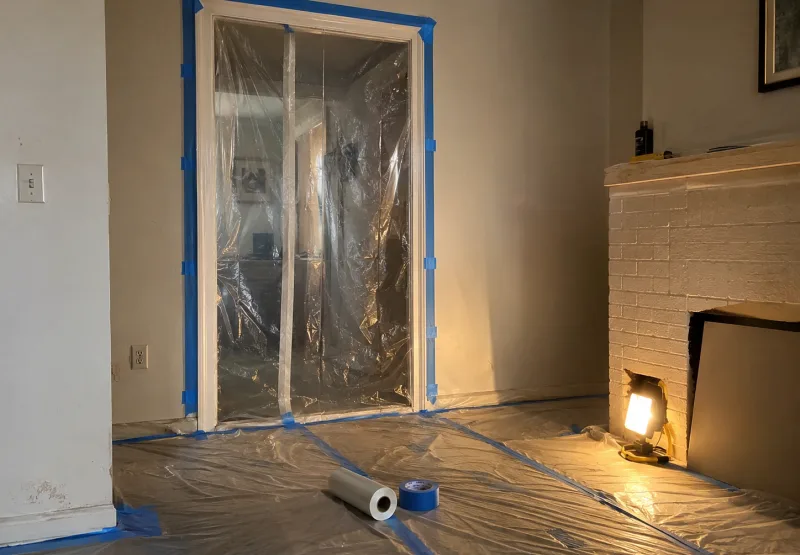
    Our crew seals and masks the work zone upon arrival. Other parts of your home remain available when the project layout permits.

  4. 4

    Spray day

    Our crew brings the spray foam rig and completes most residential installations in 1 to 2 days.

  5. 5

    Trim, coatings and cleanup

    We trim excess foam, apply coatings included in the scope, remove masking, and clean the work area.

  6. 6

    Walkthrough and closeout packet

    We compare the finished work with your scope and provide the closeout packet, including product data sheets, thickness records, warranty registration, and confirmed re-entry timing.

Step one is free.

Call to schedule your on-site estimate.

Call Now: (573) 488-6901

Spray Foam Cost Factors in Mid-Missouri

Your spray foam insulation cost comes from measurable foam volume and a defined scope. We separate material, access, prep, and removal line items so you can see what shapes the estimate.

What Drives Your Quote

We calculate board-foot volume by multiplying square footage by installed thickness. One board foot equals one square foot of foam at one inch deep. The selected foam changes the material rate because closed-cell costs more per board foot than open-cell. Tight access, old-insulation removal, surface prep, and a single-area versus whole-home scope affect labor. Any code-required barrier coating appears as its own line item.

Typical Ranges

Installed open-cell foam commonly falls within an industry range of $0.45 to $0.75 per board foot. Closed-cell foam generally runs $1.00 to $1.50 per board foot installed. Industry ranges provide a planning baseline rather than a project price.

Request a free estimate or call (573) 488-6901 for an exact figure for your building.

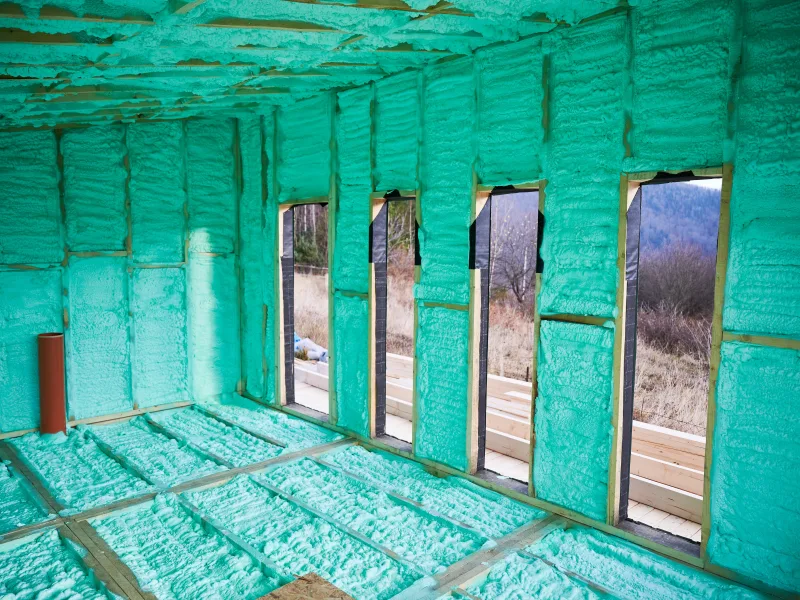
Applicator working from staging to reach a high vaulted ceiling A framed shell insulated throughout, walls, ceiling and floor joists

Spray Foam R-Values and Thermal Performance

R-value appears on every insulation quote. A short look at the measurement, material depth, and air sealing makes spray foam proposals easier to compare.

What R-Value Measures

R-value measures resistance to heat flow, and a higher number provides greater resistance. Per inch, closed-cell foam runs about R-6 to R-7, open-cell about R-3.5 to R-3.8, cellulose about R-3.2 to R-3.7, and fiberglass about R-2.2 to R-3.8. Depth-times-material arithmetic estimates the total rating for the installed thickness.

What Code Asks for in Mid-Missouri

Missouri has no statewide residential energy code, so what applies here is whichever edition Columbia has adopted. The city enforces its 2018 code family today, and a 2024 package including the 2024 IECC is scheduled to go before the council in August 2026. Mid-Missouri sits in IECC climate zone 4 either way, where attic targets start at R-49 and rise with newer editions, and walls are specified as a cavity-plus-continuous combination rather than one number. We confirm the governing figures against the code in force when the permit is pulled. Separately, what a material delivers in place is not always what the package says, because air moving through leaky insulation drags heat with it, and foam’s air seal helps it perform near its rated number.

Moisture, Humidity and Indoor Air

Columbia’s humid weather makes foam insulation and moisture control parts of the same building decision. The assembly must manage airborne vapor, ground moisture, and cold surfaces while allowing wet materials to dry.

Where Columbia Buildings Take On Moisture

Columbia averages about 41 inches of precipitation a year, and humid summers add a steady moisture load. Vented crawl spaces draw humid outdoor air while exposed soil releases ground moisture. Warm, moisture-laden air can then condense on rim joists, basement concrete, and the underside of metal roofs. Dew point at cold surfaces means the surface temperature has fallen low enough for airborne water vapor to become liquid.

How the Right Assembly Keeps Things Dry

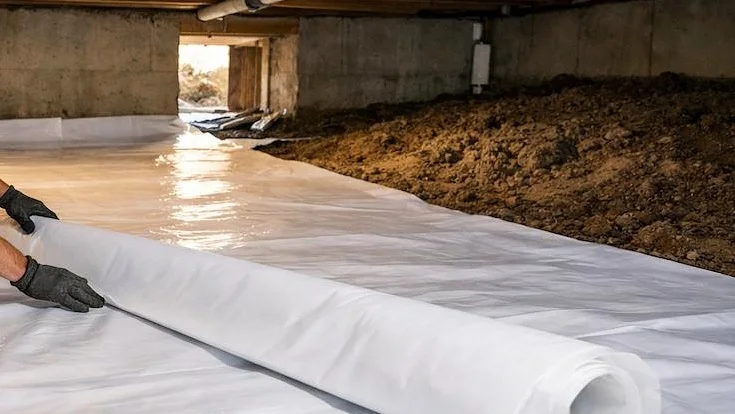
Where the vapor retarder belongs depends on the assembly, and closed-cell foam on a moisture-exposed surface slows vapor movement at that face. In crawl spaces, encapsulation limits ground moisture while dehumidification controls the air that remains. The same 19% wood moisture limit that decides whether we spray applies here, because framing closed in behind foam while still damp has little opportunity to dry inward. Controlling ground moisture, indoor humidity, and cold condensing surfaces is what keeps framing inside that range.

About Columbia, Missouri

Columbia combines a university and healthcare center with the farms and small communities of Boone County. The University of Missouri campus sits near downtown; a few miles out, Rock Bridge Memorial State Park and the Katy Trail mark where the open land starts. That mix creates varied insulation needs, including historic-home retrofits, commercial spaces, metal buildings, and pole barns on nearby farm ground. In one week we might be in a 1920s house off West Broadway on Monday and a machine shed outside Hallsville on Thursday, and the two jobs have almost nothing in common except the rig parked out front. Our service area spans Boone, Cooper, Howard, and Randolph counties.

Local buildings face winter and summer extremes. Long-term normals put January near 31 °F and July near 79 °F, with roughly 35 days above 90 °F in a typical year. The city has grown steadily for decades, and it shows in the building stock: new subdivisions going up around the edges while older properties in East Campus and the West Broadway Historic District still carry insulation installed decades ago. Spray foam can address air leakage and uneven coverage in both.

Areas Columbia Spray Foam Works Serves

  • Ashland
  • Hallsville
  • Centralia
  • Boonville
  • Fayette
  • New Franklin
  • Harrisburg
  • Sturgeon
  • Rocheport
  • Hartsburg
  • Moberly
  • Higbee
Downtown Columbia, Missouri at sunset

What Mid-Missouri Property Owners Say

Frequently Asked Questions

How Much Does Spray Foam Insulation Cost in Columbia?

There is no flat rate. Price follows board-foot volume, so the foam type, the area covered, and the installed thickness all move it, and a single rim joist sits in a different range entirely from a whole-house retrofit. The on-site estimate is free, and financing can spread the payment over time.

Are There Insulation Rebates in Columbia?

Yes, and they are worth checking before you book work. Columbia Water & Light runs a Home Performance rebate program covering up to $500 each for attic, wall, and crawl-space wall insulation, up to $300 for duct insulation, and up to $100 for air sealing, capped at $1,200 combined. A separate low-interest loan program covers larger projects and carries its own insulation minimums, R-50 in the attic among them. One thing to settle up front: the program starts with a building assessment by one of the utility’s certified Home Performance contractors, so check with Columbia Water & Light how your project qualifies before committing to anything. We supply the thickness records and product documentation an application needs.

Is There a Downside to Spray Foam Insulation?

Two real ones. It costs more upfront than fiberglass, and a bad installation is genuinely hard to undo, because cured foam bonds hard to whatever it touched and taking it back off is slow hand work. That second one is the whole reason we work the way we do. Off-ratio material is the usual culprit behind failed foam, so the mix and the proportioner temperature get watched on every pass rather than spot-checked. Applied thickness gets recorded as it goes on. And the specification is in writing before we start, which is what lets you hold the finished job against what you paid for. The downside of spray foam is nearly always a downside of the installer.

Is Open-Cell or Closed-Cell Foam Better?

Neither one wins outright. Open-cell suits deeper interior cavities and sound-sensitive rooms; closed-cell suits moisture exposure and shallow assemblies that still need a high R-value.

Can Spray Foam Be Added to an Existing Home?

Yes. Crews can insulate attics, crawl spaces, and rim joists without a major remodel. Wall cavities usually receive foam when drywall or exterior cladding is already open.

Does Old Insulation Need to Be Removed First?

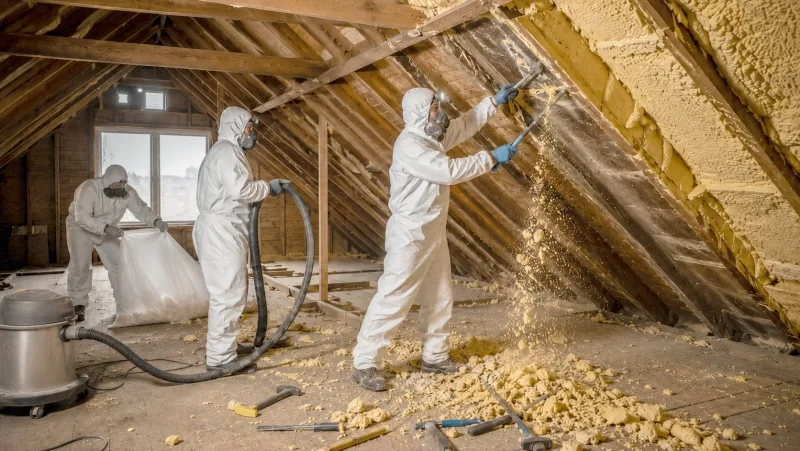
Wet, contaminated, or deteriorated insulation must come out. Clean, dry loose-fill can sometimes remain when the assembly allows it. An on-site assessment determines what stays.

How Long Does Spray Foam Insulation Last?

Properly installed foam has no replacement cycle the way loose fill does. It will not slump out of a rafter bay or settle into the bottom third of a wall, so it keeps performing at close to its installed R-value for the life of the assembly. We have been back inside houses we insulated more than a decade ago and found the foam doing what it did on day one. What shortens that is bad application, not age.

How Long Does Installation Take, and When Can We Come Back Inside?

A typical residential project takes 1 to 2 days. Most products call for about 24 hours of ventilation after spraying ends before re-entry, subject to manufacturer instructions. Your scope provides the exact job-specific return time.

Is Spray Foam Safe With Kids and Pets in the House?

Not while we are spraying. Everyone leaves the work area during application and stays out until the manufacturer re-entry interval has passed, usually about 24 hours after spraying ends, pets included. We isolate and ventilate the zone, but the honest answer is that nobody should be in the building during that window. Once the foam has cured properly it is inert and the house is normal again. Fish tanks and caged animals need a little planning, since they do not relocate as easily as a dog.

Can You Spray Foam in Winter?

Yes, and winter is when most people finally call. The constraint is not the calendar, it is substrate temperature: foam has to land on a surface warm enough to cure, or you get weak adhesion and reduced yield from the same material. In an unheated crawl space or a metal building in January, that can mean pre-heating the space with indirect-fired heat, or moving to a warmer day. We check the substrate before spraying rather than after, and we will tell you when conditions are wrong instead of spraying anyway.

Do You Work With Builders on Construction Schedules?

Regularly. The insulation slot on a build is narrow and it sits between inspections, so we schedule around framing, electrical, plumbing, and mechanical sign-offs rather than turning up and hoping. Most residential installs are one to two days. If a trade runs late we would rather move than spray over something that still needs correcting, because foam over an unfinished rough-in is an expensive thing to undo.

Are You Insured, and Do You Offer Free Estimates?

Yes. We carry general liability and workers’ compensation insurance. You can request a certificate before work begins, and estimates cost nothing.

Still have a question? Call (573) 488-6901 and ask our team directly.

Get a Free Spray Foam Estimate in Columbia

Talk with Columbia Spray Foam Works about your insulation project at (573) 488-6901, or send the details through our quote form. We serve Columbia and surrounding Mid-Missouri communities. Our team will assess the property on site and provide a free written estimate that defines the proposed scope and price before you make any commitment.